A neobank for Kenya. Two sides, one platform.
Mobile money for consumers. Web tools for merchants.
Two users. One system.
Kenya has mobile money but fragmented commerce. Consumers needed one place to pay, transfer money, and order locally.
Merchants needed a way to receive payments, manage orders, and reach customers without building their own infrastructure. Cashia was designed for both sides of that relationship.
Two jobs. Two interfaces. One connection.
I started by separating the two user journeys. A consumer's job is to move money quickly and discover what's nearby. A merchant's job is to receive payments, track orders, and manage their presence on the platform.
These are different workflows that had to connect - but share no UI. I mapped the information architecture and flows for both before designing a single screen.

Wireframes first. UI second.
I ran the full cycle: IA, flow maps, wireframes, prototyping, mockups, style guide, and user testing.
For the consumer mobile app: onboarding with phone, OTP, and Face ID, a wallet for send, request, deposit, and withdraw, bill payments with favorites, and local merchant discovery.
For the merchant web interface: product and service listings, an order management dashboard, payment confirmation flows, and merchant profile setup.

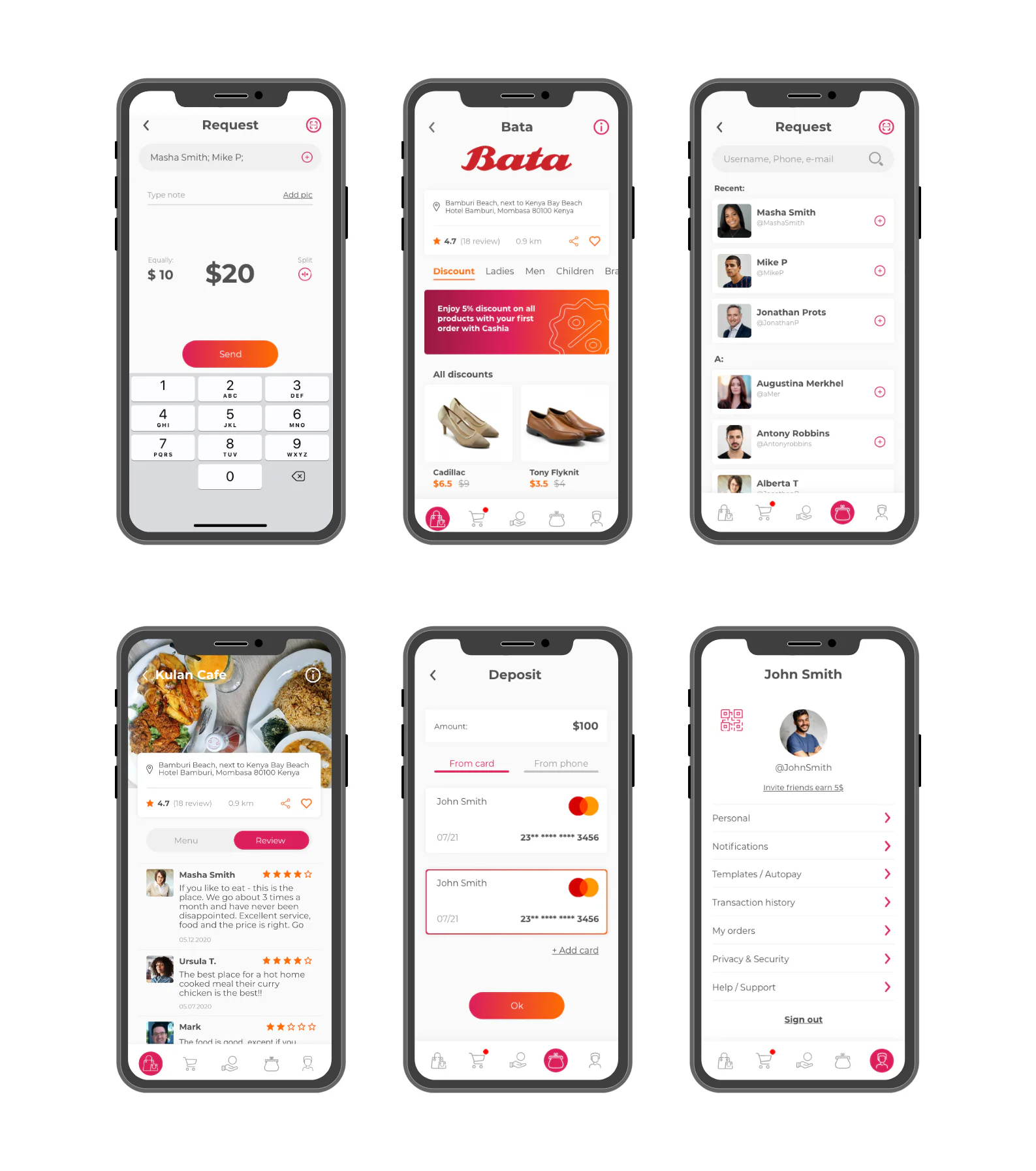

Both sides delivered.
The consumer app covered payments, wallet, and discovery. The merchant web interface gave sellers tools to manage orders and payments. The style guide established a shared visual language across both products.
What I'd do differently.
User testing happened too late, after high-fidelity prototypes were already done. The merchant interface especially needed more wireframe-stage testing. The order management logic was more complex than I'd assumed, and I found that out too late.